

Key Takeaways
- Suicidal thoughts and depression in new fathers are more common than the culture admits, with pooled research showing about 4.2% prevalence during pregnancy and early parenting 3.
- Paternal postpartum depression often looks like irritability, working late, drinking more, or numbness rather than sadness, and it tends to peak between 3 and 6 months after birth 9.
- Prior mental health history raises odds nearly sevenfold, and unemployment, financial strain, and a partner’s own depression all significantly compound risk 2.
- If thoughts of self-harm are present, call or text 988 tonight; otherwise, tell one person out loud this week and book a telehealth psychiatric evaluation that fits a working schedule.
The Late-Night Thought You’re Not Supposed to Have
It’s 2:47 a.m. The baby finally went down. Your partner is asleep. You’re staring at the ceiling, or at your phone, and a thought just moved through you that you don’t want to say out loud. Maybe it was that everyone would be fine without you. Maybe it was quieter than that. Maybe it just felt like you can’t keep doing this.
If that’s where you are right now, you’re not broken, and you’re not the only one. Fathers do get hit by depression and dark thoughts during pregnancy and after a baby arrives. It’s real, it’s measurable, and it has a name. Researchers have been studying it for years, even though almost nobody warned you it could happen to you 1.
This piece won’t tell you to just talk to someone or hand you a hotline and move on. It will tell you what the actual numbers look like for new dads, what warning signs to watch for in yourself, what raises your risk, and what you can do tonight and over the next two weeks — including options that don’t require taking a day off work. If things feel urgent right now, you can call or text 988 anytime.
How Common Suicidal Thoughts Really Are in New Fathers
Here’s the part almost nobody tells you at the hospital, the baby shower, or the pediatrician’s office: dark thoughts during and after pregnancy are more common in fathers than most people would guess. Not rare. Not a fluke. Not something wrong with you specifically.
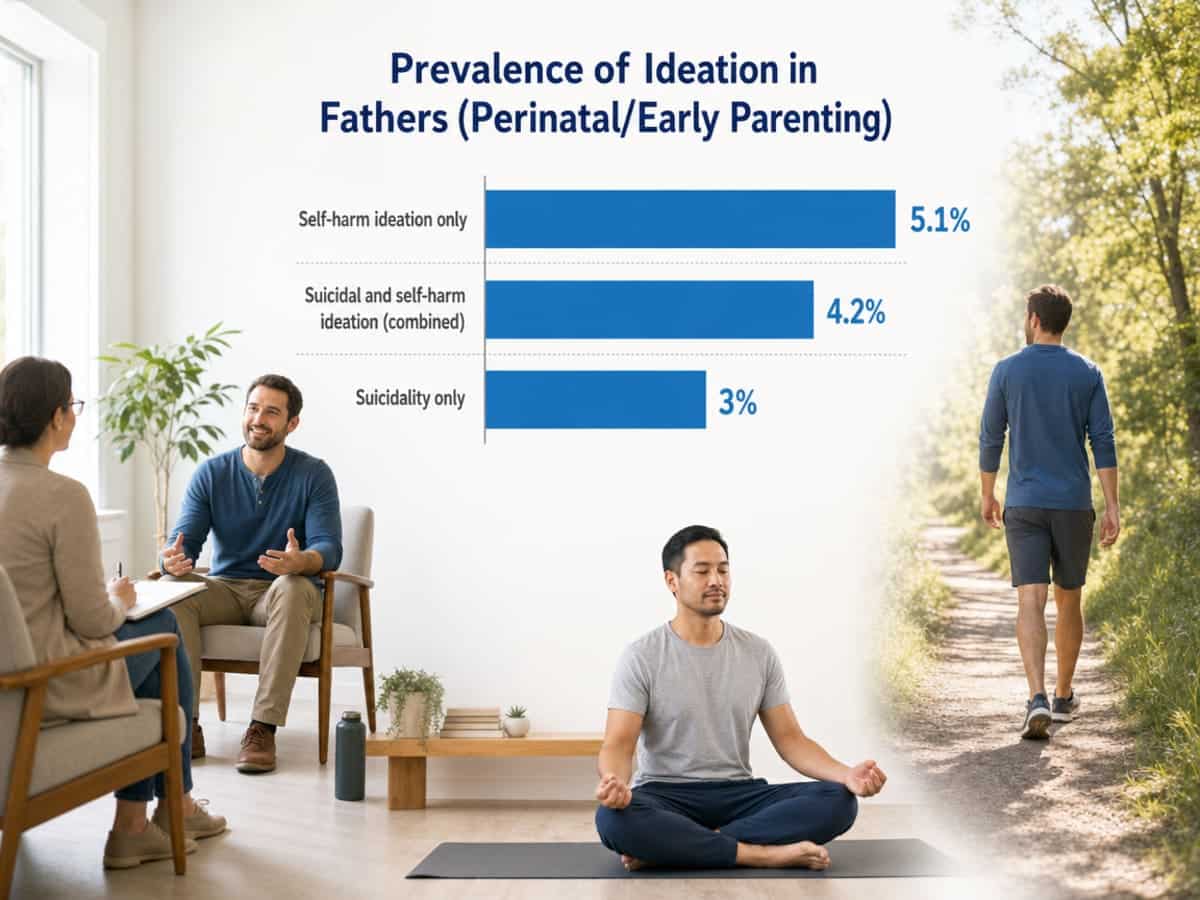
A 2024 meta-analysis pooled 14 studies from 2000 to 2023 to figure out how often fathers actually have suicidal or self-harm thoughts during pregnancy and early parenting. The combined pooled prevalence was 4.2%. When researchers looked at self-harm ideation on its own, the number was 5.1%. Suicidality on its own came in at 3% 3. Those three numbers matter separately, because they’re not the same thing, and collapsing them into one scary headline hides what’s actually going on.
A separate clinical study of postpartum fathers found a suicide risk prevalence of 4.8% in that population 6. And in a recent qualitative study, roughly 11% of fathers described experiencing thoughts of suicide or self-harm — a higher share, likely because those men self-selected into a study about paternal depression 7. Different samples, different methods, same direction: this is not a one-in-a-million experience.
To put that in perspective, if you were in a room with 24 other new dads from your prenatal class or your office, statistically at least one of you has had a thought in this range recently. Probably more, since most men don’t report it.
What these numbers do not mean: they do not mean 4.2% of fathers will act on those thoughts. Suicidal ideation is a symptom, the way chest pain is a symptom. It’s a signal that something needs attention, not a verdict on where things are headed. Plenty of fathers who have had these thoughts get treatment, feel better, and go on to be present, steady parents.
What these numbers do mean: if the thought that moved through you last night felt shameful or alien, it isn’t. It’s a recognized clinical experience with a research literature behind it. You are not the first father to have it, and you will not be the last. The next sections will help you figure out what to do with that information — starting with why the medical system probably never asked you about it in the first place.
Why Fathers Are Missed by the System
Here’s the honest truth about how postpartum care is set up in the U.S.: it was built around the person who gave birth. That makes sense on paper. The mother has appointments, screenings, a six-week follow-up, a pediatric visit schedule that keeps her in front of clinicians. You, on the other hand, show up as a support person. Nobody hands you a clipboard. Nobody asks how you’re sleeping, whether you’ve been drinking more, or whether you’ve had thoughts of not being here.
The major clinical guidelines reflect that gap. ACOG’s practice guideline on perinatal mental health screening is thorough on depression, anxiety, bipolar disorder, and suicidality — for the birthing patient 11. Fathers are not the explicit target. When mental health conditions are now the leading underlying cause of pregnancy-related death in the U.S., the system’s attention understandably went there first 12. But that focus leaves you invisible.
Fathers in a recent qualitative study named this directly. They described feeling excluded by services, given no information, and pushed by masculine norms and time pressure to keep quiet about what they were feeling 5. One phrase in that research stuck: paternal depression gets whispered in the darkest corners of the internet, not spoken about in clinics 7. If nobody has asked you, that doesn’t mean you’re fine. It means the question isn’t on the form yet. You may have to bring it up first — and the next sections give you language for that.
What Paternal Postpartum Depression Actually Looks Like
Signs That Show Up in Dads, Not Moms
Most of what’s written about postpartum depression describes what it looks like in moms: tearfulness, sadness, trouble bonding with the baby, guilt about not feeling connected. If you read that list and thought, “That’s not me, so I must be fine,” you’re not alone. And you might also be missing what’s actually happening.
In fathers, paternal postpartum depression often wears a different face. Instead of sadness, it shows up as irritability that surprises you — snapping at your partner over the dishwasher, feeling road rage you didn’t used to have, a short fuse with coworkers. Instead of withdrawal into bed, it can look like working late on purpose, staying at the office when you don’t need to, or scrolling your phone for two hours in the driveway before going inside.
Other patterns show up too. Drinking more than you used to, or earlier in the day. Reaching for weed, sports betting, porn, or online shopping in a way that feels compulsive rather than fun. Losing interest in things you used to look forward to. Feeling numb around the baby when you expected to feel overwhelmed with love. Sleeping badly even when the baby finally sleeps. Physical stuff: headaches, back pain, gut problems, a chest that feels tight for no reason.
And then there are the intrusive thoughts. Not just “I’m tired.” Thoughts like everyone would be better off without you, or that you can’t do this, or images that scare you when they show up uninvited. These count. They are symptoms, not character flaws 1. If you recognized yourself in three or more of these, the next section is for you.
When It Tends to Hit: The 3-to-6 Month Window
Here’s a timing detail that catches a lot of fathers off guard. Paternal postpartum depression affects roughly 8 to 10 percent of fathers, and it peaks between 3 and 6 months after the baby is born 9. Not the first week. Not the first month. Later.
That matters because the standard postpartum checkup calendar is built around your partner, and it’s mostly front-loaded: a two-week check, a six-week check, and then things thin out. By the time paternal depression is most likely to hit you, your partner’s OB visits are winding down, the pediatrician is focused on the baby’s weight and shots, and nobody is scheduled to ask how you are.
The practical read: if you felt okay for the first two months and are starting to feel worse now at month four or five, that’s not you finally cracking under normal-dad stress. That’s the exact window when clinicians who study this expect symptoms to surface 9. The delayed timing is also part of why fathers get missed — the systems built to catch depression aren’t looking in the right months. Knowing the window exists lets you name what’s happening earlier, instead of assuming something has just gone permanently wrong with you.
What Raises Your Risk
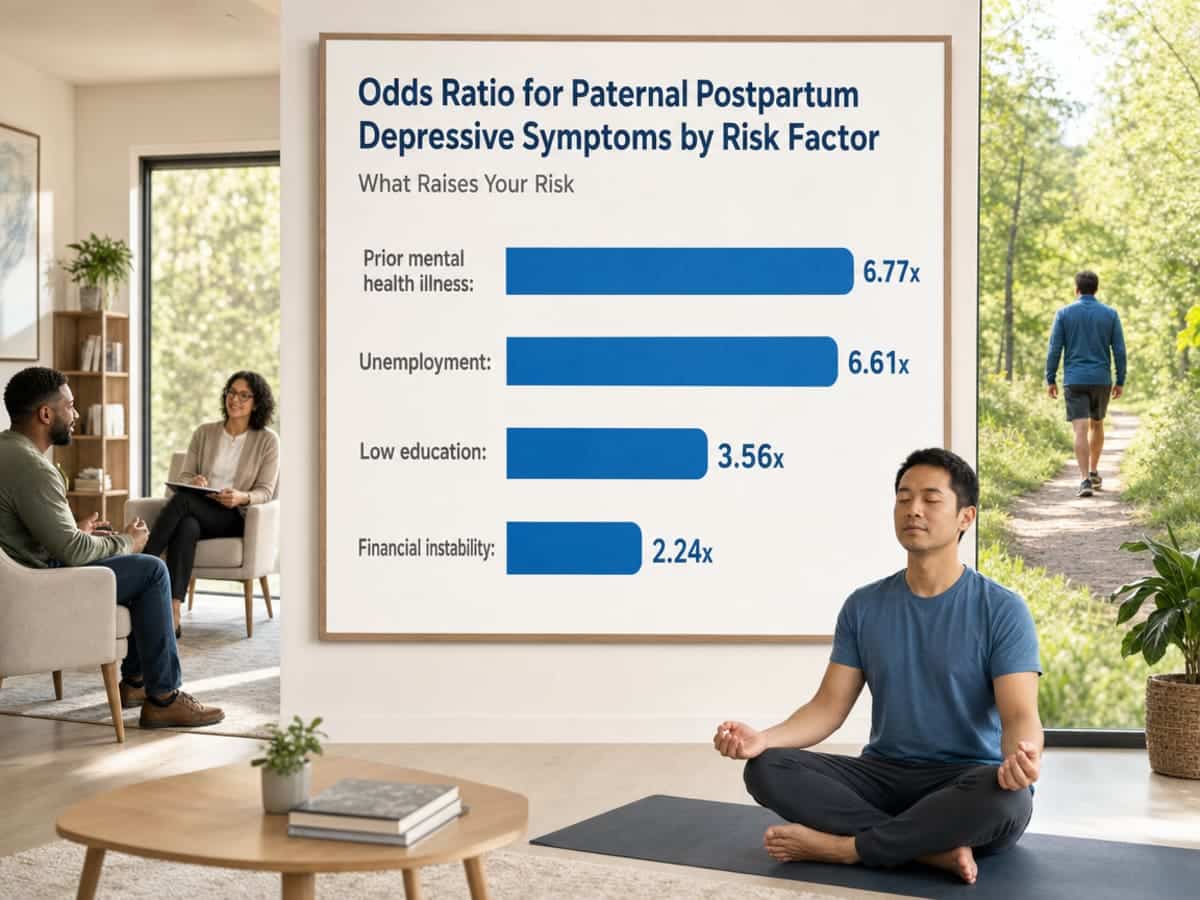
Not every new dad ends up in this territory, and some fathers are carrying heavier loads into the delivery room than others. A 2021 systematic review that pooled 25 studies covering 13,972 fathers put actual numbers on the factors that push paternal postpartum depression risk up the most 2. Reading these odds isn’t about diagnosing yourself. It’s about seeing whether your life right now happens to sit near the higher end of the curve, so you can be honest with a clinician about what you’re carrying.
The single biggest risk factor is a prior mental health illness. Fathers with any history of depression, anxiety, or another mood condition had 6.77 times higher odds of postpartum depressive symptoms than fathers without that history 2. If you saw a therapist in college, went on an SSRI in your twenties, or white-knuckled through a rough patch after a breakup years ago, that history matters here. It doesn’t make paternal PPD inevitable. It does mean the baseline you’re starting from is different.
Unemployment came in almost as high, with 6.61 times the odds 2. Low education level was linked to 3.56 times higher odds, and financial instability — being behind on bills, worried about rent, watching daycare quotes come in higher than your mortgage — showed 2.24 times higher odds 2. These aren’t personality flaws. They’re pressure. When your ability to provide feels shaky at the exact moment a new person is depending on you to provide, your nervous system reads that as a threat, and depression is one of the ways it responds.
Other risk factors matter too, even though the odds ratios vary more across studies: relationship dissatisfaction with your partner, your partner’s own depression, poor sleep, and a sense that the stress of this transition is more than you can handle 2. Paternal PPD tends to travel with maternal PPD — if your partner is struggling, your own risk goes up, and vice versa 1.
A Self-Check You Can Run Tonight
You don’t need a clinician’s office or an appointment to get a rough read on where you actually are. You need ten quiet minutes and honesty with yourself. This isn’t a diagnosis. It’s a signal check — the same way you’d notice a warning light on your dashboard before deciding whether to pull over.
Over the last two weeks, how often has each of these been true?
- You’ve felt down, flat, or hopeless more days than not.
- You’ve lost interest in things you used to enjoy — food, sex, hobbies, your friends, your kid.
- You’ve been sleeping badly even when the baby lets you sleep.
- You’ve been more irritable or angry than usual, or your fuse feels shorter than it used to.
- You’ve been drinking more, using more, or reaching for something compulsively to take the edge off.
- You’ve felt like a failure as a partner, a father, or a provider.
- You’ve had thoughts that you’d be better off gone, or that your family would.
- You’ve had thoughts of hurting yourself, even briefly.
If three or more of these have been true most days for the past two weeks, that meets the threshold clinicians use to take a closer look. Screening guidance for fathers using the Edinburgh Postnatal Depression Scale suggests referral at scores that map roughly to this level of symptom load, with a cutoff of 8 in some protocols and 10 in others 4, 10. The exact number matters less than the pattern.
If you said yes to either of the last two items — thoughts about being gone or hurting yourself — that one answer is enough. You don’t need to add up anything else. That’s the item clinicians treat as its own signal, and it deserves a conversation with someone this week, not eventually 11.
Write down what you noticed. A note on your phone is fine. You’re going to use it in the next section when you decide what to do with this information — tonight, or in the next two weeks.
What to Do in the Next 24 Hours, and the Next 2 Weeks
If You’re in Crisis Right Now
If you’re having thoughts of hurting yourself, or a plan is forming in your head, or you’re not sure you can keep yourself safe until morning — stop reading and call or text 988. That’s the Suicide and Crisis Lifeline. It’s free, it’s 24/7, and you don’t have to be actively in the act of hurting yourself to use it. You can say, “I’m a new dad and I’m having thoughts I don’t want to have.” That’s enough. They will stay on the line with you.
If you have access to a firearm, medications you’ve been thinking about, or another means, tell someone in your house tonight and have them hold it for you. Put physical distance between you and the method. That single step is one of the most effective things you can do in an acute moment.
If you feel unsafe being alone, go to the nearest emergency room or ask someone to drive you. You are not overreacting. Suicidality is a symptom that clinical guidelines treat as urgent, the same way chest pain is treated as urgent 11.
If You’re Not in Crisis but Something Is Wrong
You’re not in an emergency. You’re just tired in a way that doesn’t feel normal, or angry more than you used to be, or noticing thoughts you’d rather not be having. That’s the exact place where taking action in the next two weeks matters most, because this is when things are still workable without a crisis.
Start here, this week: tell one person out loud. Your partner, your brother, a friend who’s been through their own hard patch, your primary care doctor. You don’t need a speech. “I think I might be depressed. It started after the baby came” is enough. Naming it once, to one human, breaks the private loop that keeps this stuff running longer than it needs to. Fathers in a 2025 study said one of the biggest barriers to help was simply never being asked and never saying it out loud 5.
Next, book something. A psychiatric evaluation, a therapy intake, or a visit with your primary care doctor and ask specifically about paternal postpartum depression. If the earliest in-person slot is three weeks out, ask about telehealth — most psychiatric providers now offer virtual evaluations that fit into a lunch break. Bring the note you wrote from the self-check. It saves you from having to explain everything twice.
In the meantime, pull back on alcohol and anything else you’ve been using to take the edge off. It masks the signal and makes sleep worse. Get outside once a day, even for ten minutes. These aren’t cures. They’re floor supports while you get real help lined up.
Getting Psychiatric Care That Fits a Working Dad’s Life
The reason a lot of fathers stall out here isn’t that they don’t want help. It’s that the math doesn’t work. You have client calls Monday morning, standup at 10, a delivery date, a partner who’s running on three hours of sleep, and a baby who needs to be held. Taking a Tuesday afternoon off to drive across town, sit in a waiting room, and fill out intake forms feels impossible. So the appointment doesn’t get made. Fathers in a 2025 study named exactly this pattern — time pressure, financial pressure, and services that weren’t built around their schedules kept them from getting seen 5.
Here’s what has actually changed in the last few years. Telehealth psychiatry is now a real, standard option, not a pandemic workaround. A psychiatric evaluation over video from your car in a parking garage, or from your home office after the baby goes down, counts the same clinically as an in-person visit. Medication, if it’s warranted, can be prescribed and managed the same way. Counseling sessions can run early morning, over lunch, or after 7 p.m. — the hours a working dad actually has.
Mind Body Optimization is one outpatient practice built around this reality. Integrated psychiatric evaluation, medication management, and counseling — including virtual appointments across Texas, Tennessee, Oklahoma, and Missouri — are structured so a father can see a psychiatrist and a therapist without rearranging his job. Most major insurance is accepted, which matters when daycare quotes are already stretching the budget. That same integrated model is offered by other outpatient providers too; the point isn’t the brand, it’s that this kind of access exists now, and it’s the version of care most likely to actually get used by a father who otherwise wouldn’t book anything.
One practical tip: when you call to schedule, say the words “paternal postpartum depression” or “new dad, having a hard time.” It routes you faster and gets you in front of someone who won’t be surprised by what you’re describing.
For Partners, Family, and Friends Reading This on His Behalf
You noticed something. That’s why you’re here. Maybe he’s shorter with you than he used to be, or working hours that don’t make sense, or drinking more, or gone quiet in a way that feels different from tired. Trust that instinct. Fathers in a 2025 study said one of the biggest barriers to getting help was that nobody asked them directly, and masculine norms made it hard to volunteer it 5. You being the person who asks matters.
How you bring it up changes whether he can hear it. Skip the ambush at the end of a hard day. Try something plain, in a low-stakes moment: “You’ve seemed off since the baby came. Not judging. I just want to know how you actually are.” If he deflects, don’t push once and drop it. Come back in a few days. Persistence signals you’re not going away.
If he tells you he’s had thoughts of not being here, or of hurting himself, take it seriously the first time. You don’t need to fix it. Sit with him, help him call 988, or drive him to an ER if he says he isn’t safe. If there’s a firearm or stockpiled medication in the house, ask to hold it somewhere else for now. That single step reduces risk in an acute window.
One more thing: offer to help book the appointment, not just to suggest one. Telehealth psychiatric evaluations exist and can happen from home during a lunch break. Making the call together is often the difference between an intention and an actual visit.
Take the First Step Toward Feeling Supported
Connect with someone who understands the pressures new fathers face and start finding your footing again.

Frequently Asked Questions
Can dads really get postpartum depression, or is that just a mom thing?
Yes, fathers get it too. Research estimates paternal postpartum depression affects roughly 8 to 10 percent of dads, with community sample ranges as wide as 4 to 25 percent depending on how it’s measured 9, 8. It’s a recognized clinical condition, not a mood or a phase. Most fathers just never get asked about it, so it stays invisible.
What number do I call if I’m having thoughts of hurting myself tonight?
Call or text 988. That’s the Suicide and Crisis Lifeline in the U.S., free, confidential, and staffed 24/7. You don’t have to be in the middle of a crisis to use it. Saying “I’m a new dad and I’m having thoughts I don’t want to have” is enough. If you feel unsafe alone, go to the nearest emergency room.
How is paternal postpartum depression different from what moms experience?
It often wears a different face. Instead of tearfulness and sadness, dads tend to show irritability, anger, a shorter fuse, working late to avoid home, drinking or scrolling more, and feeling numb around the baby rather than connected. Intrusive thoughts show up too. Timing also differs — paternal PPD tends to peak between 3 and 6 months postpartum, later than the maternal window most checkups target 9.
I can’t take time off work for appointments. Is telehealth psychiatry a real option?
Yes. Telehealth psychiatric evaluation and medication management are now standard care, not a workaround. A virtual visit from your car during lunch or from home after the baby goes down counts the same clinically as an in-person session. Counseling can run early morning, at lunch, or after 7 p.m. Fathers in a 2025 study named time and financial pressure as core barriers — telehealth was built to solve exactly that 5.
My partner just had our baby and something seems off with him. What should I do?
Trust the instinct. Ask him directly in a calm moment: “You’ve seemed off since the baby came. How are you actually doing?” If he deflects, come back a few days later. If he mentions thoughts of not being here or hurting himself, take it seriously the first time — help him call 988, sit with him, or drive him to an ER. If firearms or stockpiled medication are in the house, offer to hold them elsewhere. Offer to book the appointment with him, not just suggest one 5.
Will getting psychiatric help go on my record or affect my job?
Your mental health care is protected health information under HIPAA. Your employer doesn’t see your diagnosis, your medications, or your therapy notes unless you choose to share them. Insurance uses coded billing that stays inside your medical record. For most working dads, an evaluation and treatment happen quietly in the background of a normal workweek — especially when telehealth is part of the plan.
References
- Postpartum Depression in Fathers: A Systematic Review. https://pmc.ncbi.nlm.nih.gov/articles/PMC11122550/
- Risk factors for postpartum depressive symptoms among fathers: A systematic review. https://pubmed.ncbi.nlm.nih.gov/33539548/
- Prevalence of suicidal and self-harm ideation in fathers during the perinatal and early parenting period: A systematic review and meta-analysis. https://pubmed.ncbi.nlm.nih.gov/39118251/
- Paternal Perinatal Mental Health: Information and Recommendations for Maternal and Child Health Programs. https://www.kdhe.ks.gov/DocumentCenter/View/2882/Information-and-Recommendations-PDF
- Paternal perinatal mental health support: fathers’ perspectives and experiences. https://pmc.ncbi.nlm.nih.gov/articles/PMC11925843/
- Risk of suicide and mixed episode in men in the postpartum period. https://pubmed.ncbi.nlm.nih.gov/21277023/
- “Whispered on Only the Darkest Corners of the Internet”: A qualitative study of paternal postpartum depression. https://pmc.ncbi.nlm.nih.gov/articles/PMC12476499/
- Sad Dads: Paternal Postpartum Depression. https://pmc.ncbi.nlm.nih.gov/articles/PMC2922346/
- Postpartum Depression in Men. https://pmc.ncbi.nlm.nih.gov/articles/PMC6659987/
- Sensitivity and reliability of screening measures for paternal postpartum depression: an integrative review. https://pmc.ncbi.nlm.nih.gov/articles/PMC8752439/
- ACOG Clinical Practice Guideline No. 4: Screening and Diagnosis of Mental Health Conditions During Pregnancy and Postpartum. https://pubmed.ncbi.nlm.nih.gov/37486660/
- New Resources Available for Perinatal Mental Health Conditions. https://medi-calrx.dhcs.ca.gov/cms/medicalrx/static-assets/documents/provider/dur/educational-articles/dured_New_Resources_Available_for_Perinatal_Mental_Health_Conditions.pdf